Fluoride didn’t enter America’s drinking water because it was discovered in a pristine mountain spring.
It entered through smokestacks, scrubbers, and chemical runoff.
Long before fluoride was branded a public-health hero, certain fluoride compounds were a serious industrial waste problem — expensive to capture, expensive to neutralize, and expensive to dispose of. Then something changed. What once cost companies millions to manage became something municipalities would pay for instead.
That transformation didn’t happen by accident. And it didn’t happen without controversy.
Long before fluoride was branded a public-health hero, certain fluoride compounds were a serious industrial waste problem.
Natural Fluoride vs. Industrial Fluoride — These Are Not the Same Thing
This distinction is often blurred in public conversations, but it matters.
Natural fluoride
Natural fluoride occurs in some spring and groundwater sources, typically as calcium fluoride, dissolved slowly through rock over time.
Fluorosilicic acid
A municipal fluoride additive commonly identified as fluorosilicic acid (H₂SiF₆).
Sodium fluorosilicate
Another municipal fluoride additive commonly identified as sodium fluorosilicate (Na₂SiF₆).
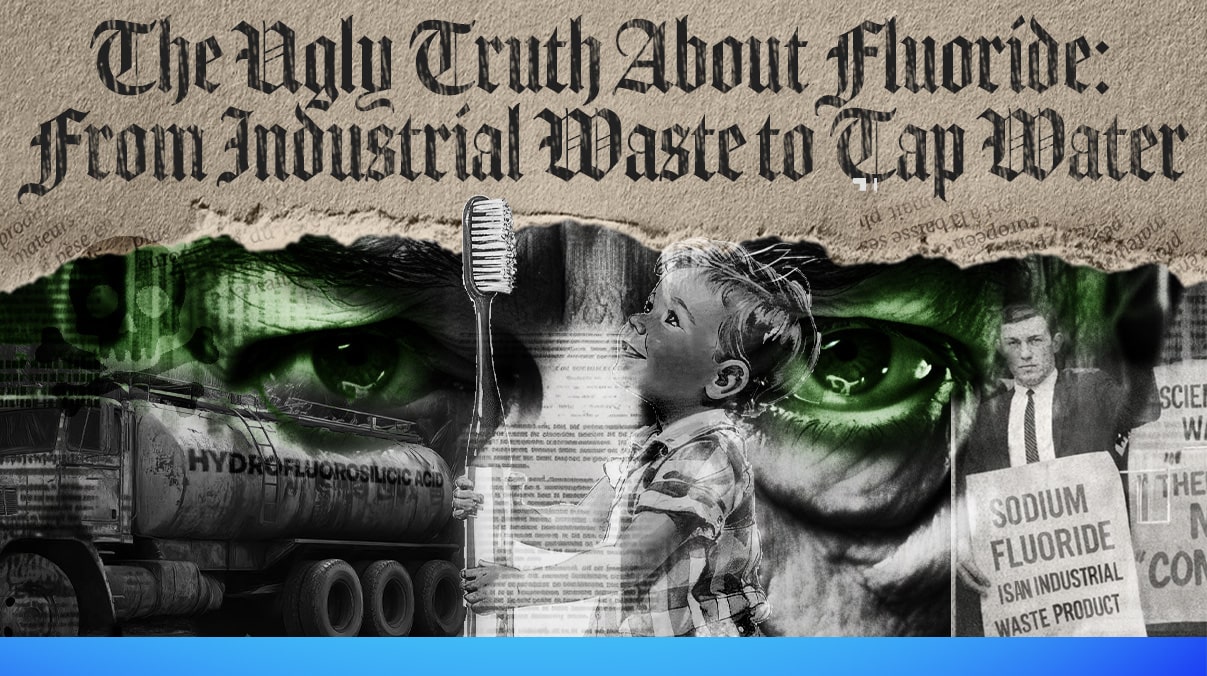
Municipal fluoride additives, however, are most commonly fluorosilicic acid (H₂SiF₆) or sodium fluorosilicate (Na₂SiF₆) — compounds captured from phosphate fertilizer and aluminum production.
According to historical analysis published by Ohio State University’s Origins journal, these compounds were once treated as toxic industrial waste — a disposal liability for major manufacturers.
This isn’t conjecture. It’s documented industrial history.
When Waste Became “Public Health”
What had once escaped freely into air and water was now a regulated waste stream with real financial consequences.
In the early-to-mid 20th century, industries producing fluoride-rich emissions faced growing pressure to control air and water pollution. Chemical plants and phosphate fertilizer facilities installed scrubbers on smokestacks to capture hazardous byproducts before they were released into the environment.
That solved one problem — and created another.
The captured fluorosilicic compounds had to go somewhere. Disposal was expensive. Neutralization was expensive. Long-term storage was expensive. What had once escaped freely into air and water was now a regulated waste stream with real financial consequences.
What followed was not an accident, but a reframing.
Instead of paying to dispose of these compounds, manufacturers found a buyer: municipal water systems. Fluoride, newly framed as a cavity-fighting public-health tool, shifted from industrial liability to marketable product.
Archival records and historical accounts suggest this transition was not universally welcomed at the time. Engineers responsible for pollution control viewed fluorosilicate capture as an environmental necessity — not a consumer good. Some public-health officials expressed caution about introducing an industrial compound into drinking water, even as others emphasized early evidence of reduced tooth decay.
There was no single decision point. No secret meeting. No moment where the switch was flipped.
What emerged instead was gradual normalization — driven by regulatory pressure, economic practicality, and early studies that appeared to validate fluoridation’s benefits. As fluoridation became policy, institutional momentum took hold. Dissenting voices were not erased, but they were increasingly sidelined as the practice became standard.
As Ohio State University’s Origins journal documents, this period also coincided with aggressive promotion of fluoridation as a public good — often without clearly distinguishing naturally occurring fluoride from industrial fluorosilicates used in municipal systems.
That history does not automatically make fluoridation unsafe.
But it absolutely complicates the narrative — and it helps explain why a policy born from industrial waste management and public-health optimism has remained largely unquestioned for decades.
“Is Fluoride Bad for You?” Is the Wrong First Question
The more honest question starts with the fluoride, the dose, the source, and the length of exposure.
The more honest question is:
Which fluoride, at what dose, from what source, over what period of time?
Public agencies often defend fluoridation by pointing to naturally fluoridated water sources. But that comparison glosses over chemistry, sourcing, and exposure pathways.
Even the Centers for Disease Control and Prevention acknowledges that fluoride’s primary benefit is topical — acting on tooth enamel — not systemic nutrition.
So when people ask “is fluoride bad for you?”, what they’re really asking is whether mass-medicating water with an industrially sourced compound still makes sense in a world where:
- toothpaste is ubiquitous
- dental care is widely available
- exposure is cumulative
- and alternatives exist
This Isn’t a Conspiracy — It’s an Incentives Story
There doesn’t need to be a secret cabal for something to go wrong.
There doesn’t need to be a secret cabal for something to go wrong.
All it takes is aligned incentives:
Industry
Industry needed a cheap disposal solution
Government
Governments wanted a low-cost public-health intervention
Regulators
Regulators trusted early studies and never revisited the assumptions
The fluoride story is a textbook example of this dynamic. The compounds most commonly used for water fluoridation — fluorosilicic acid and sodium fluorosilicate — originated as industrial byproducts of phosphate fertilizer and aluminum production. For manufacturers, these substances were once costly disposal liabilities. As historians have documented, repurposing them for municipal water systems transformed an environmental problem into an economic solution.
Early research into fluoridation occurred long before modern conflict-of-interest standards were in place, and while there is no documented evidence that chemical companies directly paid for fraudulent safety studies, the economic incentives were clear. Industry had waste to offload, governments wanted an inexpensive public-health intervention, and early assumptions — once accepted — were rarely revisited.
That’s how policy ossifies. That’s how narratives harden. And that’s how questions get labeled “unscientific” instead of re-examined.
As the World Health Organization itself notes, fluoride’s safety is dose-dependent — a statement that implicitly acknowledges risk is not zero.
Why More Homeowners Are Saying “No Thanks”
For some homeowners, the response isn’t panic. It’s simply wanting more information and more control.
None of this means fluoridated water is instantly dangerous.
It means the story is messier, darker, and more political than the public was ever told.
That’s why more homeowners are choosing to test, filter, and decide for themselves — not because they’re anti-science, but because they’re pro-informed consent.
And it’s why the question “is fluoride bad for you?” keeps resurfacing — not as hysteria, but as skepticism toward a 70-year-old policy rooted in an industrial workaround.
In recent years, multiple municipalities across North America and Europe have held public votes or quietly removed fluoride from their water systems, not because of panic, but because residents demanded transparency, updated risk assessments, and choice.
Test, filter, and decide for yourself.
If You Don’t Know What’s in Your Water, You’re Guessing
You don’t need to take a position to take control.
You don’t need to take a position to take control.
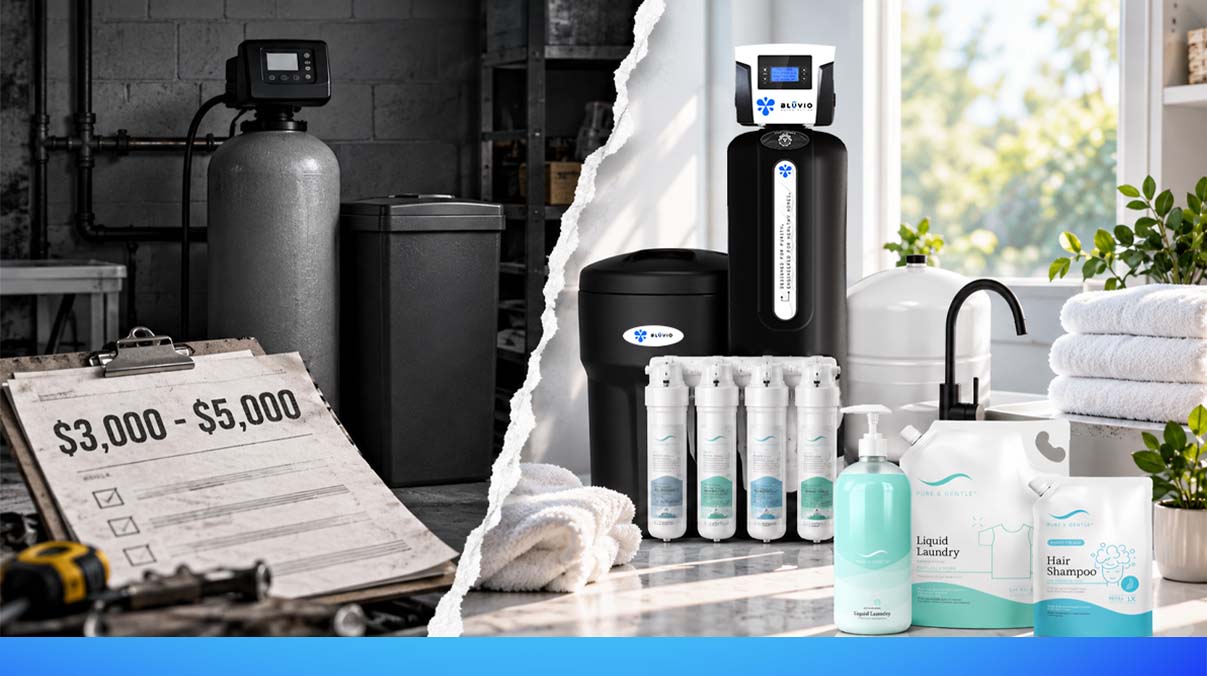
Bluvio offers free in-home water testing so you can see exactly what’s coming out of your tap — fluoride included — and decide what level of filtration, if any, makes sense for your household.
No scare tactics.
No blind trust.
Just data.
YOUR NEXT STEP
Want to See What’s In Your Water?
If you’re curious about your water quality or concerned about the impact it’s having on your home and family, Bluvio is here to help. Our free in-home water test gives you the answers you need to make informed decisions — including customized filtration recommendations for contaminants like fluoride, lead, PFAS, chlorine, arsenic, nitrates, VOCs, and more.
📍 Serving NC, SC and Southwest VA.
Fill out the form below and we’ll follow up to confirm availability in your area.