PFAS, Lead, and Heavy Metals — Explained Simply
If you’ve ever looked at a water report or headline and felt overwhelmed by chemical names, you’re not alone.
PFAS. Lead. Heavy metals.
They’re often grouped together, discussed interchangeably, and presented without context — which makes it hard to understand what actually matters and why.
So let’s strip this down to what homeowners really need to know.
No panic.
No chemistry degree required.
Just clarity.
Why These Contaminants Get So Much Attention
PFAS, lead, and heavy metals aren’t new discoveries.
What is new is our ability to detect them at extremely low levels — and to understand how long-term exposure behaves over time.
These substances tend to share three characteristics:
-
They don’t break down easily
-
They can accumulate in the body
-
They’re influenced by infrastructure, not just water source
That’s why they’re discussed together — but they are not the same thing, and they don’t come from the same places.
PFAS: “Forever Chemicals” Explained
PFAS stands for per- and polyfluoroalkyl substances — a large group of man-made chemicals used for decades in industrial and consumer products.
They’re often called “forever chemicals” because they:
-
Don’t naturally degrade
-
Persist in water and soil
-
Can remain in the body for long periods
How PFAS Enter Drinking Water
PFAS typically enter water supplies through:
-
Industrial discharge
-
Firefighting foam runoff
-
Landfills and waste sites
-
Manufacturing byproducts
Once in groundwater or surface water, they can be extremely difficult to remove using conventional municipal treatment.
That’s why PFAS regulation has evolved rapidly in recent years.
Lead: An Infrastructure Problem, Not a Treatment Failure
Lead in drinking water is almost never added intentionally.
Instead, it’s usually introduced after water leaves the treatment plant.
Where Lead Comes From
Lead most commonly enters water through:
-
Older service lines
-
Lead-based plumbing components
-
Corrosion in aging infrastructure
Even water that meets all treatment standards can pick up lead as it travels through pipes — especially in older neighborhoods.
That’s why lead is considered an infrastructure issue, not a source-water issue.
Heavy Metals: Naturally Occurring, Context-Dependent
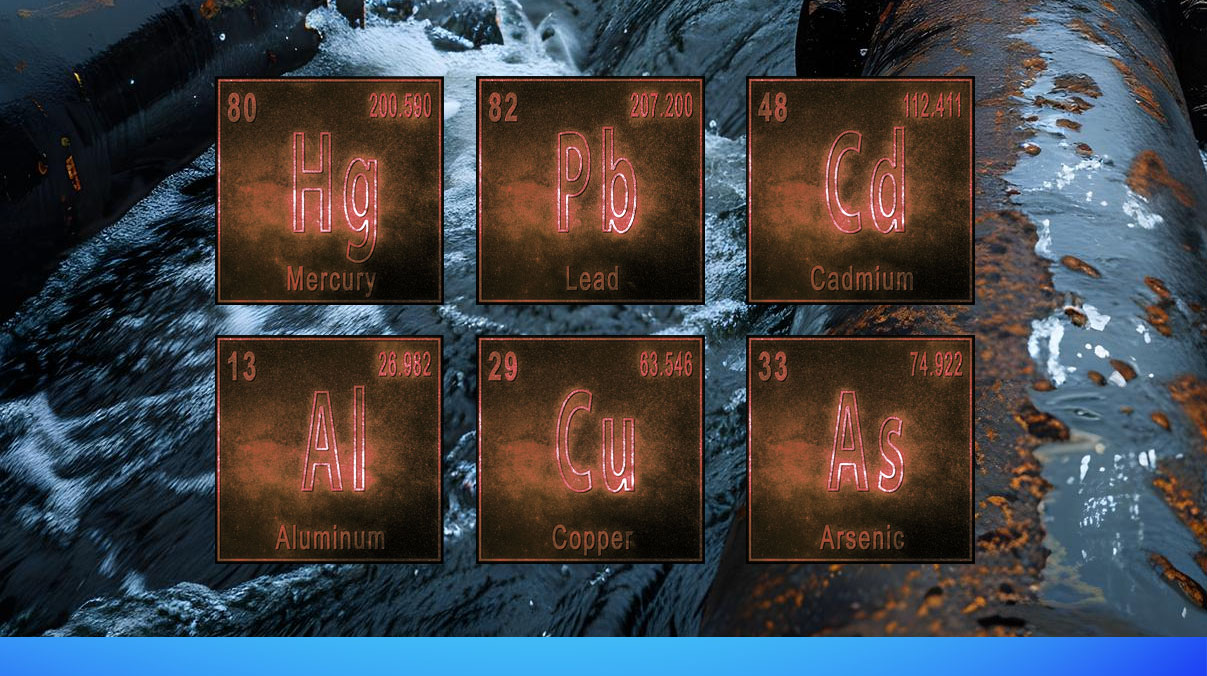
Heavy metals include elements like:
-
Arsenic
-
Mercury
-
Chromium
-
Cadmium
Unlike PFAS, many heavy metals occur naturally in soil and rock.
Why They Show Up in Water
They can enter water supplies through:
-
Natural geological contact
-
Mining or industrial activity
-
Agricultural runoff
-
Corrosion in plumbing
Their presence — and impact — depends heavily on location, water chemistry, and exposure duration.
Regulation vs. Reality
One of the biggest points of confusion is the difference between regulated limits and personal exposure.
Drinking water standards are designed to:
-
Protect public health at scale
-
Prevent acute risk
-
Balance feasibility across entire systems
They are not personalized to individual homes.
That’s why two homes on the same water system can experience very different water quality — even when both are technically compliant.
Why These Contaminants Are Hard to Remove Municipally
Municipal systems are excellent at:
-
Disinfection
-
Pathogen control
-
Broad chemical management
But contaminants like PFAS and certain metals:
-
Require specialized filtration
-
Behave differently depending on chemistry
-
Are difficult to address uniformly at scale
This doesn’t mean water systems are failing.
It means point-of-use and point-of-entry solutions exist for a reason — especially when homeowners want insight beyond population-wide averages.
The Takeaway
PFAS, lead, and heavy metals aren’t interchangeable threats.
They differ in:
-
Origin
-
Behavior
-
How they enter water
-
How they’re addressed
Understanding what they are — and how they behave — is far more useful than reacting to headlines.
The real question isn’t whether these substances exist in drinking water.
It’s how they relate to your specific home, plumbing, and water path.
That’s where clarity begins.