When most homeowners shop for a whole-home water system, they hear a lot about “carbon filtration.” It’s one of the most commonly used methods for improving water taste, smell, and reducing contaminants like chlorine and VOCs.
But what rarely gets explained is that not all carbon is created equal — and the difference between low-cost, imported carbon and high-performance, American-made carbon can mean the difference between a system that protects your home for decades… and one that fails in a few short years.
The Difference Between Filtered and Truly Protected
How Carbon Filtration Works (and Why Quality Matters)
Carbon only works as well as it’s made.
Carbon filtration works through a process called adsorption — where contaminants are trapped on the surface of carbon granules or blocks. The more porous, dense, and reactive the carbon, the better it performs.
But like any tool, carbon only works as well as it’s made. Its effectiveness depends on:
- Source material (coconut shell is highest performing; bituminous coal is lower quality)
- Activation process (how the surface area is increased for maximum contact)
- Consistency in granule size and purity
- How tightly it’s packed in the tank or cartridge
- Gallons treated before exhaustion
Poor-quality carbon can look the same — but under pressure, it breaks down faster, clogs easier, and loses its filtering ability long before the homeowner ever notices.
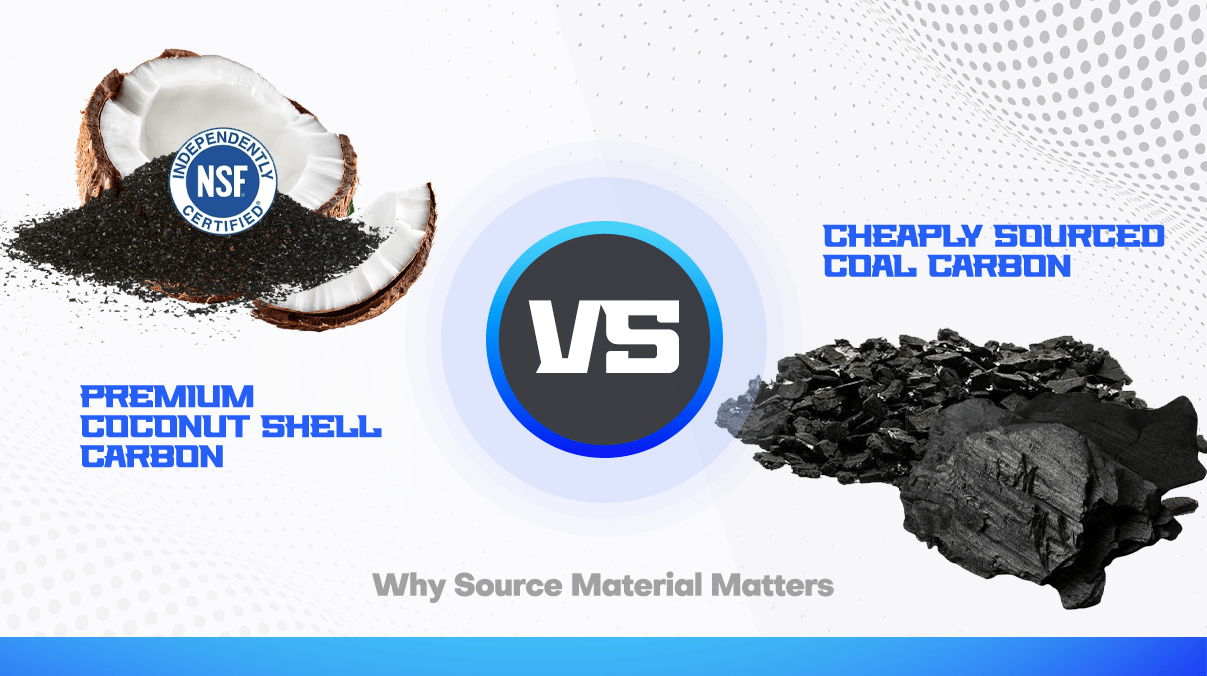
Coconut Shell vs. Bituminous Coal: Why Source Material Matters
Most homeowners don’t realize the carbon inside their system can come from two very different sources — and the quality difference is huge.
The Good Stuff
- Derived from renewable coconut shells
- Extremely dense micropores — ideal for removing chlorine, VOCs, pesticides, and THMs
- Produces low ash content, improving water clarity and reducing system fouling
- Naturally more resistant to breakdown under high pressure and long-term flow
- Preferred in high-performance residential and commercial systems
The Cheap Stuff
- Mined from the ground and often used in low-cost filtration media
- More macroporous — less surface area for trapping smaller contaminants
- Higher ash and dust content, which can clog filters and reduce efficiency
- Less predictable pore size = inconsistent filtration performance
- Frequently sourced from low-regulation regions overseas, with minimal quality control
Key Point: Coconut shell carbon is up to 4x more effective in chlorine and VOC removal than lower-grade coal-based carbon — and lasts significantly longer.
When you’re investing in a system meant to protect your whole home, this isn’t just a spec sheet detail. It’s the difference between reliable performance for 20+ years… or expensive media swaps every few years.
Cheap Carbon Filters: The $1,000+ Service Call Trap
The purchase price isn’t the only number that matters. What happens three, five, or ten years later matters too.
Many off-brand or budget filtration systems use Chinese-sourced carbon. While inexpensive to manufacture, this media often lacks quality control, certification, and long-term performance data.
Here’s the problem:
🔻 Shorter Lifespan
Low-grade carbon often has an expected lifespan of just 3 to 5 years — sometimes less in homes with high chlorine levels or heavy water usage. That means regular service calls, media swaps, or complete system re-bed costs.
🔻 Replacement Isn’t Optional
Once the carbon is exhausted, it doesn’t just stop working. It can actually become a breeding ground for bacteria, lose flow rate, or even begin to release trapped contaminants back into your water — especially if the tank lacks proper pre-filtration or sediment protection.
🔻 Proprietary Components = Expensive Maintenance
Many of these systems are built with proprietary tank sizes, fittings, and cartridges, meaning only the original company can service them. Homeowners are often quoted high fees for media swaps or full tank replacements… or pressured into buying a new system altogether when parts are no longer available.
🔻 Unknown Sourcing and Certification
Chinese-sourced carbon may not carry NSF/ANSI 61 or NSF/ANSI 42 certifications for drinking water safety or chlorine reduction. Without these benchmarks, there’s no third-party validation for:
- Pore size consistency
- Ash content
- Microporosity
- Contaminant removal efficacy
You’re trusting a label, not a proven result.
The Premium Carbon Difference
Better carbon starts with better sourcing, better processing, and tighter quality standards.
American-made catalytic coconut shell carbon — especially from trusted manufacturers like Calgon Carbon or Jacobi Carbons — is held to strict quality standards:
- Sourced and processed in NSF-certified facilities
- Optimized for chlorine, chloramine, VOCs, and pesticide removal
- Tightly graded granules for uniform performance
- Low ash and dust content to maintain flow and prevent fouling
When used in whole-home systems with proper pre-filtration, this carbon can remain effective for 20 to 25 years, especially when layered in a full-sized media tank with proper flow rate controls.
In fact, many high-end systems with this type of carbon are rated for:
Gallons of Treatment Life
Years of Potential Performance
High-Performance Filtration
Up to 1.5 million gallons of treatment life
That’s not a guess — it’s based on real-world testing, engineering specs, and certifications that ensure consistency across time and usage conditions.
Certifications That Matter
These certifications aren’t just logos — they’re proof that what’s promised on the spec sheet has been verified independently.
Look for systems that include carbon certified to the following standards:
NSF/ANSI 42
For chlorine, taste, and odor reduction
NSF/ANSI 61
For material safety in drinking water contact
WQA Gold Seal
For product integrity and third-party testing
Made in USA designations – ensuring traceable sourcing and manufacturing accountability
These certifications aren’t just logos — they’re proof that what’s promised on the spec sheet has been verified independently.
Final Thought: A System is Only as Good as Its Core
If the carbon fails, the entire system fails with it.
It’s easy to get distracted by tank size, system branding, or whether the valve comes with a Wi-Fi app. But at the heart of every whole-home system is the media — and if the carbon fails, the entire system fails with it.
If you’re comparing quotes and one system says “carbon filter included,” ask:
Know what you’re actually buying.
- What type of carbon is it?
- How many gallons is it rated for?
- Is it NSF/ANSI certified?
- Where was it made?
- What’s the cost and timeline for replacement?
Because the companies using premium carbon won’t hesitate to answer — and the ones using the cheap stuff will try to dodge the question.
THE TAKEAWAY
Buy Smart. Ask Questions. Demand Quality.
Because carbon isn’t just a filter — it’s the backbone of your family’s water protection.
🧪 Want to See What’s In Your Water?
If you’re curious about your water quality or concerned about the impact it’s having on your home and family, Bluvio is here to help. Our free in-home water test gives you the answers you need to make informed decisions — including customized filtration recommendations for contaminants like fluoride, lead, PFAS, chlorine, arsenic, nitrates, VOCs, and more.
📍 Serving NC, SC and Southwest VA.
Fill out the form below and we’ll follow up to confirm availability in your area.