You’re researching reverse osmosis (RO) systems, and everywhere you turn, you see buzz around “tankless.” Sleek. Space-saving. Modern. But behind the minimalist design and fast-talking marketing, an important question lingers:
Is newer actually better — or just different?
This guide breaks down the real differences between tank and tankless reverse osmosis systems — including performance, maintenance, lifespan, and water quality — to help you make an informed decision.
Choosing the Right RO System Isn’t Just About Looks
What Is Reverse Osmosis, Exactly?
Reverse osmosis is one of the most effective methods of water purification.
Reverse osmosis is one of the most effective methods of water purification. It works by forcing water through a semipermeable membrane that blocks up to 99% of dissolved solids, including:
- Lead
- Chlorine
- Arsenic
- Nitrates
- Fluoride
- Other unwanted contaminants
The result? Clean, crisp-tasting water — ideal for drinking, cooking, and protecting your health. According to the EPA, reverse osmosis is a proven solution for reducing many common water contaminants (EPA Drinking Water Treatment Guide).
Most residential RO systems are installed under the kitchen sink and feature multiple filtration stages, a dedicated faucet, and, in the case of traditional systems, a pressurized storage tank.
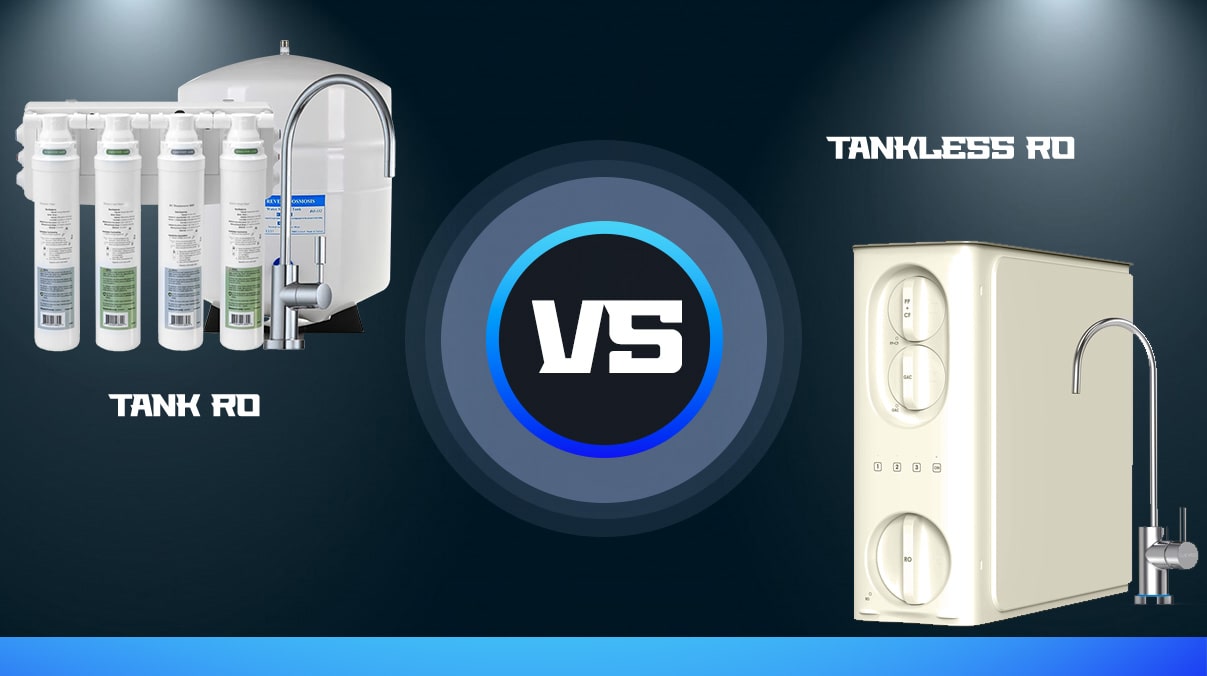
So… Tank or Tankless? Here’s How They Actually Work
The biggest difference isn’t how they look under the sink. It’s how they produce and deliver purified water.
Tank-Based RO Systems
After water passes through sediment, carbon, and the RO membrane, it enters a pressurized storage tank.
When you open the faucet, water is delivered instantly, at full pressure, without forcing the RO membrane to “keep up.”
This alone eliminates many of the common issues found in tankless systems.
Tankless RO Systems
Tankless systems purify water on demand, without storing it. The idea is to cut down on space and potential stagnation in the tank. But in doing so, the system has to work constantly and immediately — often requiring electronics, sensors, control boards, and booster pumps to keep up.
More components = more failure points.
Which Delivers Better Water Quality?
The question isn’t simply whether a system can produce purified water. It’s how consistently it can deliver it.
Tank-Based
- Full multi-stage filtration
- Stable Total Dissolved Solids (TDS) output
- No “TDS creep” (a common issue in tankless systems where TDS spikes temporarily)
- Performance is consistent, even with multiple users
Some tank-based setups even build in a final polishing stage. Bluvio’s configuration, for example, incorporates a calcite and magnesium post-filter — a targeted step that restores natural mineral balance, elevate pH levels, and and removes the flat or metallic profile that many tankless systems leave behind. This step is what allows Bluvio to deliver a premium and healthy taste in every sip.
Tankless
- Filtration quality may fluctuate under heavy demand
- Some models reduce the number of filters to increase speed
- TDS creep can occur if the membrane can’t maintain pressure
For steady, reliable purity, tank-based RO systems win — especially in households where water quality can’t be compromised.
Is Flow Rate a Concern?
How the system stores — or doesn’t store — purified water directly affects how that water reaches the faucet.
Tank-Based
- Immediate flow thanks to the pressurized tank
- Maintains strong output even when multiple faucets are used
- No lag or delay
Tankless
- Relies on real-time filtration speed
- Flow may drop sharply with simultaneous use
- Some systems throttle flow to preserve performance
📊 According to a 2022 NSF report, tankless RO systems had up to 42% slower flow rates under load compared to tank-based systems.
How About Maintenance and System Longevity?
The system you buy today is also the system you’ll eventually have to maintain and repair.
Tank-Based
- Simpler design = fewer things to break
- Lifespan of 10–15+ years with basic maintenance
- Fewer electronics = fewer service calls
- Easy-to-source filters and parts
Tankless
- More electronics = more failure points
- Pumps wear out
- Sensors fail
- Repairs often require specialized parts
- Shorter service life due to complexity
When simplicity equals longevity, reliability always wins.
Water Efficiency: Is Tankless Really Greener?
Efficiency claims look great on a spec sheet. Real-world performance is what matters inside the home.
Tankless systems often advertise lower wastewater ratios (like 1:1 pure to waste), but these numbers are often lab-tested under ideal conditions — not in real households.
Tank-based systems equipped with permeate pumps now achieve impressive efficiency too — often 2:1 or even 3:1 — without sacrificing performance.
If a tankless system saves 2 gallons a day but fails in 3 years, the landfill impact and replacement cost may outweigh the water savings.
⚖️ Build Quality, Footprint, and Practical Use
Here’s how Bluvio’s tank RO compares with a typical tankless RO across the features homeowners actually notice.
| Feature | Bluvio’s Tank RO | Tankless RO |
|---|---|---|
| Water Purity | ✔ Consistent, stable | ⚠️ Can fluctuate |
| Flow Rate | ✔ Immediate, strong | ⚠️ Drops under load |
| Taste Quality | ✔ Polished with remineralization | ⚠️ Metallic if not remineralized |
| Space Saving | ⚠️ Requires tank space | ✔ More compact |
| Maintenance | ✔ Simple | ⚠️ More complex |
| Longevity | ✔ 10–15+ years | ⚠️ Less proven |
| Repair Cost | ✔ Low | ⚠️ Higher (electronics) |
Final Take: Which Should You Choose?
The right system depends on what you value most — but reliability, water quality, and long-term ownership matter.
If you live alone in a studio apartment and value aesthetics over function, a tankless RO might work — for now.
But if you’re a homeowner looking for:
- Unmatched water quality
- Reliable performance during busy hours
- A system built to last 10–15 years
- Lower long-term maintenance risk
…then a traditional tank-based reverse osmosis system still sets the gold standard.
And that’s why Bluvio installs:
✔ Aqua Flo QCRO Tank-Based RO System
✔ Plus Calcite/Magnesium Remineralization
✔ Paired With Bluvio’s HT89 Whole-Home Conditioner Upstream
This combination delivers:
- cleaner water
- better taste
- stronger flow
- more consistent TDS
- fewer points of failure
- longer system life
- and simpler maintenance
No gimmicks.
No fragile electronics.
Just engineering that works — and keeps working.
YOUR NEXT STEP
🧪 Want to See What’s In Your Water?
If you’re curious about your water quality or concerned about the impact it’s having on your home and family, Bluvio is here to help. Our free in-home water test gives you the answers you need to make informed decisions — including customized filtration recommendations for contaminants like fluoride, lead, PFAS, chlorine, arsenic, nitrates, VOCs, and more.
📍 Serving NC, SC and Southwest VA
Fill out the form below and we’ll follow up to confirm availability in your area.