A factual, engineering-first comparison to help homeowners cut through industry nostalgia, outdated assumptions, and marketing myths.
The Truth About Modern Water Softener Valves
When homeowners start researching water softeners, the valve quickly becomes the centerpiece of the conversation. And for good reason — it’s the control head, the brain, the part that determines flow, efficiency, and long-term system performance.
For decades, Clack and Fleck have been widely recognized names in the U.S. market. Installers learned them early in their careers, parts have been readily available, and both brands built loyal followings over the years.
But they’re not the only major players — and they haven’t been for a long time.
At Bluvio, we didn’t pick our valve based on installer habit or brand familiarity. We researched, compared, tested, and pressure-checked every realistic option on the market. We asked the same question homeowners ask us:
Which valve delivers the best long-term performance — not just the best reputation?
That process led us to one sound conclusion:
Engineering is greater than emotion.
And that’s exactly why we selected the Hydrotech 89 Series— a globally established platform used throughout North America, Europe, and Asia, powering a massive number of modern softening and conditioning systems. It’s built on a more contemporary engineering philosophy than many legacy valves — prioritizing efficiency, flow behavior, electronics stability, and real-world longevity.
In other words:
We didn’t choose what’s talked about the most.
We chose what performs the best.
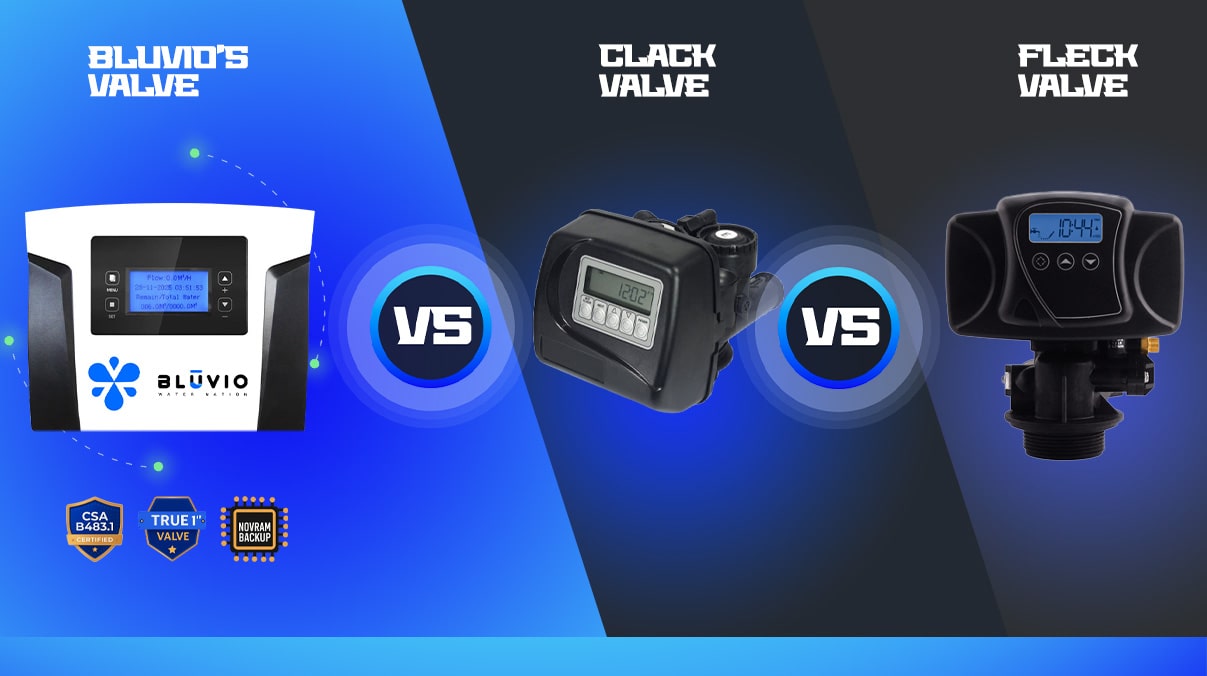
This article breaks down how the Hydrotech 89 Series (used by Bluvio) stacks up against Clack’s WS1 and the Fleck family of valves — using performance, efficiency, design, and real-world usability as the only criteria that matter.
No sentiment.
No trade-forum folklore.
Just a clear, informed comparison built for homeowners who want to understand the difference.
What a Valve Actually Does (In Plain English)
Before comparing the three platforms, it helps to understand what a valve is and why it matters.
The Valve = The Brain of the System
A water softener or whole-home conditioning system has two main parts:
-
the tank (where resin or media lives)
-
the valve (the control head that directs water, cleaning cycles, and regeneration)
The valve decides:
-
when the system cleans itself
-
how efficiently it uses salt
-
how well it maintains flow pressure
-
how stable the performance stays during outages
-
how long the internal media lasts
And like any “brain,” some are modern… others are still stuck in earlier generations of design.
Hydrotech 89 Series vs. Clack vs. Fleck — Quick Comparison Table
Below is a neutral comparison of the three platforms based on functionality, design philosophy, and verified features.
Valve Comparison Overview
|
Category |
HT89 (Bluvio) |
Clack WS1 |
Fleck (5600/5800/5810) |
|---|---|---|---|
|
Engineering Origin |
U.S. engineered; manufactured globally; modern design |
U.S. engineered; legacy reputation |
U.S. engineered; long-standing legacy |
|
Certifications |
NSF/ANSI 44 |
NSF/ANSI 44 |
NSF/ANSI 44 (varies by model) |
|
Flow Rate Capability |
Modern 1” high-flow |
Strong 1” flow |
Mixed (many ¾”, some 1”) |
|
Regeneration Type |
Upflow (efficient) |
Downflow (upflow only via specialty setups) |
Mostly downflow |
|
Cycle Efficiency |
Six optimized cleaning cycles (EcoFlow) |
Standard cycles |
Standard cycles |
|
Memory / Backup Power |
NOVRAM + power backup |
Electronic memory |
Electronic memory |
|
Industry Sentiment |
Low (newer tech) |
Very high (installer favorite) |
Very high (installer favorite) |
|
Design Era |
Modern, efficiency-driven |
Early-2000s era |
1970–1990s era (depending on model) |
This table gives the overview. Now let’s break down what the differences actually mean for a homeowner.
Upflow vs. Downflow Regeneration
Why Regeneration Style Matters
Regeneration is how a softener “cleans itself.” The way the salt brine flows through the resin determines:
-
how much salt you use
-
how clean the resin stays
-
how long the system lasts
-
how much water is wasted
Downflow (Clack & Fleck Standard)
Downflow means water flows from the top down, the traditional approach.
Pros:
-
Older, well-established design
-
Trusted by many installers
Cons:
-
Uses more salt
-
Less efficient media cleaning
-
Resin compresses rather than expands
Upflow (HT89 Advantage)
Upflow pushes water from bottom up, expanding the resin like a sponge.
Pros:
-
More efficient salt usage
-
Better cleaning = longer resin life
-
Lower water waste
-
Modern engineering approach
Upflow = efficient. Downflow = familiar.
If efficiency is the goal, upflow wins almost every time.
Cycle Efficiency — Why More Cycles (Done Right) Matter
Cycle count varies by valve design.
The HT89 uses a six-cycle sequence optimized for cleaning, brining, rinsing, and media protection.
What More Cycles Actually Do
-
Clean resin more thoroughly
-
Reduce channeling
-
Improve consistency of softened water
-
Extend resin lifespan
-
Lower long-term salt expense
Clack and Fleck both have dependable cycles, but fewer stages and less granular control.
The Modern Difference
Where older valves rely on legacy cycle structures, the HT89 leverages electronic optimization—similar to how modern washing machines outperform older mechanical ones.
Memory Backup & Power Stability
Why Backup Memory Matters
If the power goes out—even briefly—less modern valves may:
-
lose their schedule
-
mistime regenerations
-
waste salt
-
disrupt water quality
HT89’s NOVRAM Memory System
This memory style:
-
stores all valve settings
-
retains regeneration schedules
-
protects against power flickers
-
reduces maintenance calls
Clack and Fleck both include memory on electronic models, but NOVRAM is more stable and built for modern power environments.
Certification Breakdown: What Actually Matters (and What Doesn’t)
Most homeowners never look at product certifications — but they should.
They’re one of the few forms of third-party proof in the water treatment industry. Not marketing.
Not hype.
Not installer opinion.
Just independent verification that a system performs the way it’s supposed to.
But it’s important to understand which certifications apply to which components.
Valves, tanks, and complete softener systems are tested differently.
NSF/ANSI 44 — The Gold Standard for Water Softening Performance
NSF/ANSI 44 is the certification that matters most when comparing valves.
It verifies that the softening system:
-
actually reduces hardness minerals
-
delivers consistent performance under load
-
meets regeneration efficiency standards
-
functions safely under typical household pressure
-
performs to the capacity listed by the manufacturer
HT89:
✔ Certified
Clack WS1:
✔ Certified
Fleck:
✔ Certified (varies by specific model)
This is the core certification for softener performance — and all three platforms meet it.
CSA B483.1 — Additional Residential Safety Standard
This is a Canadian residential drinking water component standard that complements NSF 44.
It ensures:
-
materials are safe for contact with drinking water
-
the system is designed for residential use
-
performance claims meet defined thresholds
HT89:
✔ Certified
Clack:
Varies by distributor and tank system configuration.
Fleck:
Varies by model and assembly.
CSA B483.1 isn’t required in the U.S., but when a manufacturer has it, it’s a signal that the system meets higher cross-border compliance standards.
Certification Summary
✔ NSF/ANSI 44 = Verified water softening performance
✔ CSA B483.1 = Additional residential safety standard (HT89 advantage)
Sentiment vs. Engineering — The Modern Divide
Installer sentiment can drive strong opinions in the water treatment world.
Fleck and Clack both carry decades of goodwill because they’ve been the default choice for years.
But goodwill is not engineering.
The Emotional Bias in Valve Discussions
-
“My shop has always used Clack.”
-
“I trust Fleck because it’s been around forever.”
-
“If it ain’t broke, don’t fix it.”
These are emotional stances—not technical ones.
Why Engineering Wins
Modern plumbing demands:
-
higher flow
-
more efficiency
-
better electronics
-
lower maintenance
-
verified certifications
-
smarter regeneration tech
And that’s where engineering > emotion.
Final Verdict — Which Valve Wins in 2025?
The Fair Conclusion
-
Clack is reliable, trusted, and time-tested.
-
Fleck is simple, durable, and widely known.
-
HT89 is modern, efficient, and engineered for the future—not the past.
If your priority is:
✔ familiarity → Clack or Fleck
✔ performance, efficiency, and long-term value →
HT89
Why Bluvio Uses the HT89 Valve
We focus on measurable outcomes:
cleaner water, better flow, lower cost of ownership, verified certifications, and stable long-term performance.
Not nostalgia.
Not emotion.
Not industry habit.
Just pure engineering.
🧪 Want to See What’s In Your Water?
If you’re curious about your water quality or concerned about the impact it’s having on your home and family, Bluvio is here to help. Our free in-home water test gives you the answers you need to make informed decisions — including customized filtration recommendations for contaminants like fluoride, lead, PFAS, chlorine, arsenic, nitrates, VOCs, and more.
📍 Serving NC and Southwest VA.
Fill out the form below and we’ll follow up to confirm availability in your area.